Case study — Methodology
Listening Before You Intervene — the listening tour as research method
A methodology essay in human systems research — how structured listening surfaces the patterns that conventional user research misses.
Most research is designed to answer questions you already have
Surveys, usability tests, A/B tests — they're all validation instruments. They tell you whether your hypothesis holds, and they're excellent tools when you've correctly identified the problem. The trouble is that most research is commissioned before you know what the problem actually is, and the instruments themselves foreclose the questions you haven't thought to ask yet.
You end up with very precise answers to the wrong questions.
Listening tours are designed to surface the questions you should have been asking. Structurally, a tour is a series of open-ended conversations with people at multiple positions within a system: end users, practitioners, administrators, adjacent stakeholders, people who've moved through the system and left it. Each conversation is loosely structured around a few open questions, and the method's discipline comes from who you talk to and how you synthesize what you hear. The goal is to understand the system's internal logic — how it actually works, as opposed to how it was designed to work — before you try to change anything.
A diagnostic for systemic dysfunction
Listening tours are most useful at the beginning of an intervention. They're the right method when:
You're entering a new system
A new organizational or civic system whose internal logic you don't yet understand.
The data doesn't explain the gap
Existing data can't account for the distance between how a system was designed and how it's actually operating.
The implementers need to own the understanding
The people who will eventually carry out a change need to be part of building the understanding that motivates it.
They're a poor fit for feature-level user research or a discovery sprint in a known problem space. They're a diagnostic for organizational or systemic dysfunction — the kind that stays out of analytics and satisfaction scores, because the people inside the system have adapted around it without naming it.
A creative studio that couldn't name its friction
A client — an information design studio — was experiencing friction they couldn't name. Output was fine, client satisfaction was fine, but something was off in how the team worked together. Leadership had a theory about process, another about workload, and a third about team chemistry, and they'd been rotating through half-interventions for about a year.
I began with a listening tour: 45-minute conversations with each person on the team plus three past clients, structured around two or three open questions about what the work felt like at its best and where energy went to waste.
The synthesis revealed something none of the theories had named. The studio's implicit hierarchy didn't match its stated values. Senior designers were systematically protecting junior team members from direct client relationships — handling the hard conversations, absorbing ambiguous feedback, running interference before briefs reached the people doing the work. Internally this was framed as mentorship. The junior designers experienced it as exclusion — a signal that they weren't trusted, that they were being managed rather than developed.
That finding shaped a completely different intervention than anyone had initially proposed. The problem wasn't process or workload. It was an unacknowledged belief about who was ready for what — and the tour made it possible to name that without anyone having to be the one who said it first.
Designing the Delta accessibility study before designing it
Before designing primary research for a major airline's accessibility services — a multi-surface system touching booking, ground operations, in-flight experience, and post-trip resolution — I ran a pre-research listening tour with disability justice advocates to understand the political and systemic context before I designed a single interview guide.
The tour was pure intelligence gathering. I wanted to understand what advocates and community organizers already knew: where previous accessibility research efforts had failed to produce change, what the community's actual priorities were versus what organizations typically assumed they were, and where the system had historically broken down in ways that didn't appear in service data. The conversations were explicitly framed as informing my research design rather than generating research findings. That framing mattered — it invited a different kind of honesty.
What I learned shaped everything about the subsequent study: who I recruited, what I chose not to ask (because it had already been asked to no effect), and what the research needed to be trying to learn in order to be useful. The study it produced became the Delta accessibility research.
Position-based sampling, and the discipline of not theming early
The sampling strategy in a listening tour is organized around position in the system rather than demographic profile or user segment. That's a deliberate choice reflecting a specific theory of how organizations and systems actually function. A front-line service worker, a policy administrator, a long-time participant, someone who recently stopped engaging, an adjacent advocate — these people have structurally different views of the same system, because each position only makes certain things visible.
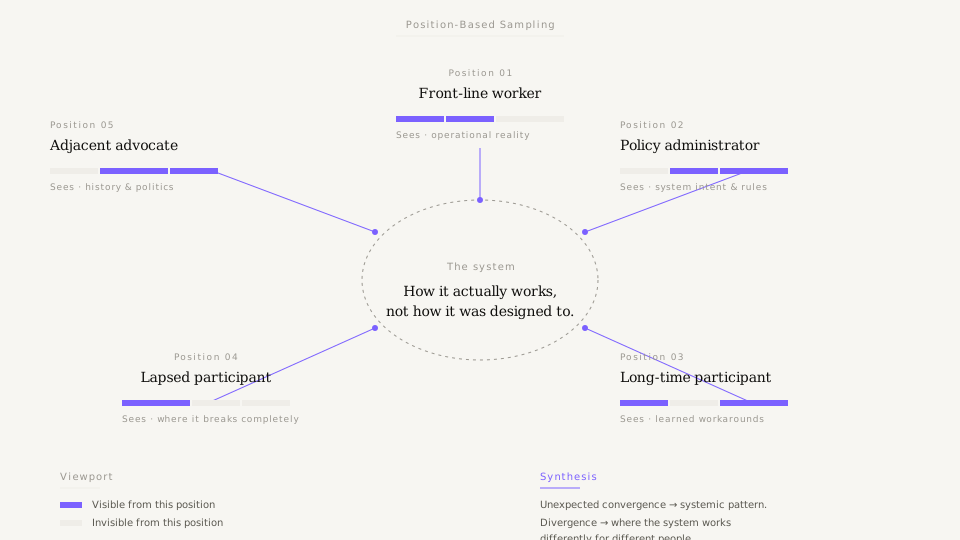
When a front-line worker and a policy administrator describe the same process completely differently, that gap is a structural seam in how the system was built — and those seams are where interventions have to go.
The synthesis move asks for a matching discipline — a few principles I hold to:
Resist premature categorization
It's tempting to start theming early, to build an affinity map as you go. The method's value comes from holding multiple accounts together long enough to notice what the early categories would have hidden.
Watch for unexpected convergence
When people in very different positions, with different stakes, describe something the same way, that's usually a systemic pattern — a structural feature of the system.
Read divergence as an equity signal
Divergences are places where the system is working differently for different people, which is often where the equity analysis has to happen.
Synthesize for symptoms
The synthesis is about figuring out what the data is a symptom of.
What listening tours don't do
They don't produce the kind of evidence that justifies a specific design decision. They're not evaluative, and they're not meant to be.
If you run a listening tour and immediately know what you're going to build, you probably weren't actually listening — you were confirming.
The output of a well-run listening tour is a more precise problem statement and a better-designed subsequent study. That's its value: it resets the research agenda before you've locked in the wrong one. The discipline is accepting that the method's deliverable is understanding.
That understanding is what makes everything that comes after more likely to matter.